California is often viewed as a pioneer in labor protections, and its approach to workers’ compensation is no exception. For business owners operating in the Golden State, navigating the maze of legal requirements can feel like a full-time job in itself. However, understanding workers’ compensation insurance isn’t just about legal compliance—it’s about protecting your most valuable asset: your people. In this guide, we will break down the essential requirements, the nuances of coverage, and the consequences of staying on the wrong side of the law.
The Fundamental Rule: Who Must Carry Insurance?






In California, the law is remarkably straightforward: all employers must provide workers’ compensation insurance, even if they have only one employee. This rule applies regardless of whether the employee is full-time, part-time, or even a temporary hire. The state’s Labor Code Section 3700 mandates that every employer shall secure the payment of compensation by either being insured against liability by one or more insurers duly authorized to write compensation insurance in California or by securing a certificate of consent to self-insure from the Director of Industrial Relations.
There are very few exceptions. Even roofers who have no employees must still carry workers’ compensation insurance under specific state licensing laws. For almost everyone else, if you cut a paycheck to a human being for work performed, you likely need a policy.
Defining the “Employee” in the Post-AB5 Era
A common point of confusion for many California business owners is the distinction between an employee and an independent contractor. With the passage of Assembly Bill 5 (AB5) and the subsequent adoption of the “ABC Test,” the criteria for who qualifies as an independent contractor have tightened significantly.
To treat a worker as a contractor, the business must prove:
1. The worker is free from the control and direction of the hiring entity.
2. The worker performs work that is outside the usual course of the hiring entity’s business.
3. The worker is customarily engaged in an independently established trade, occupation, or business.
If a worker does not meet all three criteria, they are legally an employee, and you are required to provide workers’ compensation coverage for them. Misclassifying employees as contractors to avoid insurance premiums is a high-risk gamble that California regulators watch closely.
What Does Workers’ Compensation Cover?
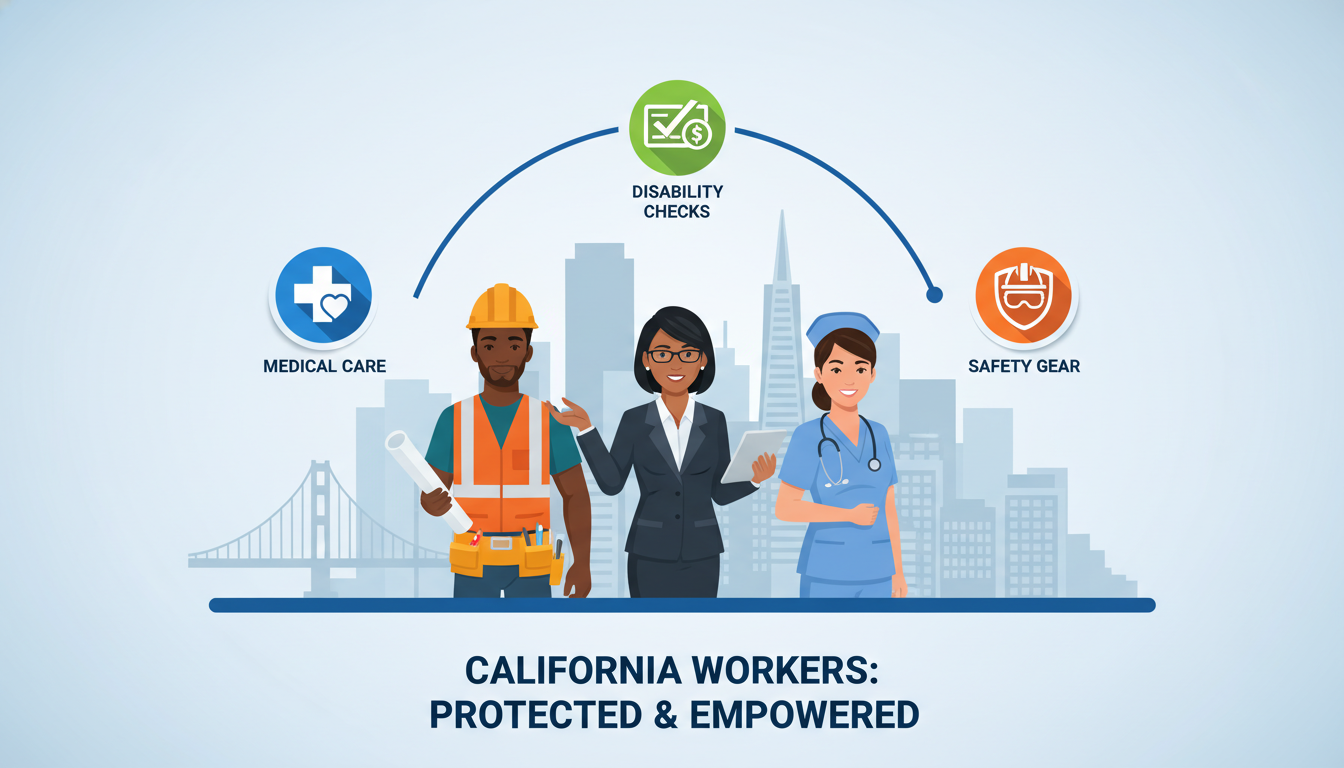
Workers’ compensation is a “no-fault” system. This means that an injured worker does not have to prove the employer was negligent to receive benefits. In exchange, the employer is generally shielded from civil lawsuits related to the injury. The benefits provided typically fall into five categories:
1. Medical Care: Paid for by the employer to help the employee recover from an injury or illness caused by work.
2. Temporary Disability Benefits: Payments if the employee loses wages because the injury prevents them from doing their usual job while recovering.
3. Permanent Disability Benefits: Payments if the employee does not recover completely.
4. Supplemental Job Displacement Benefits: Vouchers to help pay for retraining or skill enhancement if the employee cannot return to work for the employer.
5. Death Benefits: Payments to the spouse, children, or other dependents of an employee who dies from a work-related injury or illness.
The Cost of Non-Compliance: A Heavy Price to Pay
Skipping out on workers’ compensation insurance in California is a recipe for financial and legal disaster. The state treats it as a criminal offense—specifically a misdemeanor punishable by either a fine of up to $10,000 or imprisonment in the county jail for up to one year, or both.
Beyond criminal penalties, the Division of Labor Standards Enforcement (DLSE) can issue a “Stop Order” against your business. This legally forces you to cease all operations until you secure insurance. If you ignore a Stop Order, you could face additional fines of $10,000 or more. Furthermore, if an employee gets hurt while you are uninsured, you are responsible for paying all their medical bills and disability benefits out of pocket, and the employee has the right to sue you in civil court in addition to filing a workers’ comp claim.
How to Obtain Coverage
California employers have three primary avenues for securing coverage:
- Private Insurance Carriers: There are hundreds of licensed private insurance companies in California that compete for your business. It is often beneficial to work with a broker who can compare rates.
- State Compensation Insurance Fund (State Fund): Created by the state legislature, the State Fund is a non-profit, self-supporting public enterprise. It is the “insurer of last resort,” meaning it must provide coverage to any employer, even those in high-risk industries that private insurers might reject.
- Self-Insurance: Large, financially stable companies can apply for the privilege of self-insuring. This requires a significant net worth and the posting of a security deposit to ensure they can cover potential claims.
Required Postings and Record-Keeping
Compliance doesn’t end with buying a policy. California law requires you to post a “Notice to Employees” poster in a conspicuous location at the worksite. This poster must include details about your insurance carrier and where employees can get medical care. You must also provide a Workers’ Compensation Claim Form (DWC 1) and a Notice of Potential Eligibility to any employee within one working day of learning about a work-related injury.
Final Thoughts for the California Business Owner
Navigating the California workers’ compensation landscape might seem daunting, but it is a vital pillar of a healthy business ecosystem. By viewing these requirements not just as a regulatory hurdle, but as a framework for workplace safety and financial security, you can foster a culture of trust with your team.
Ensure you review your policy annually, keep meticulous payroll records, and stay updated on any legislative changes. While the premiums are an added expense, the peace of mind knowing that your business—and your employees—are protected from the unpredictable is an investment that pays dividends in long-term stability.